
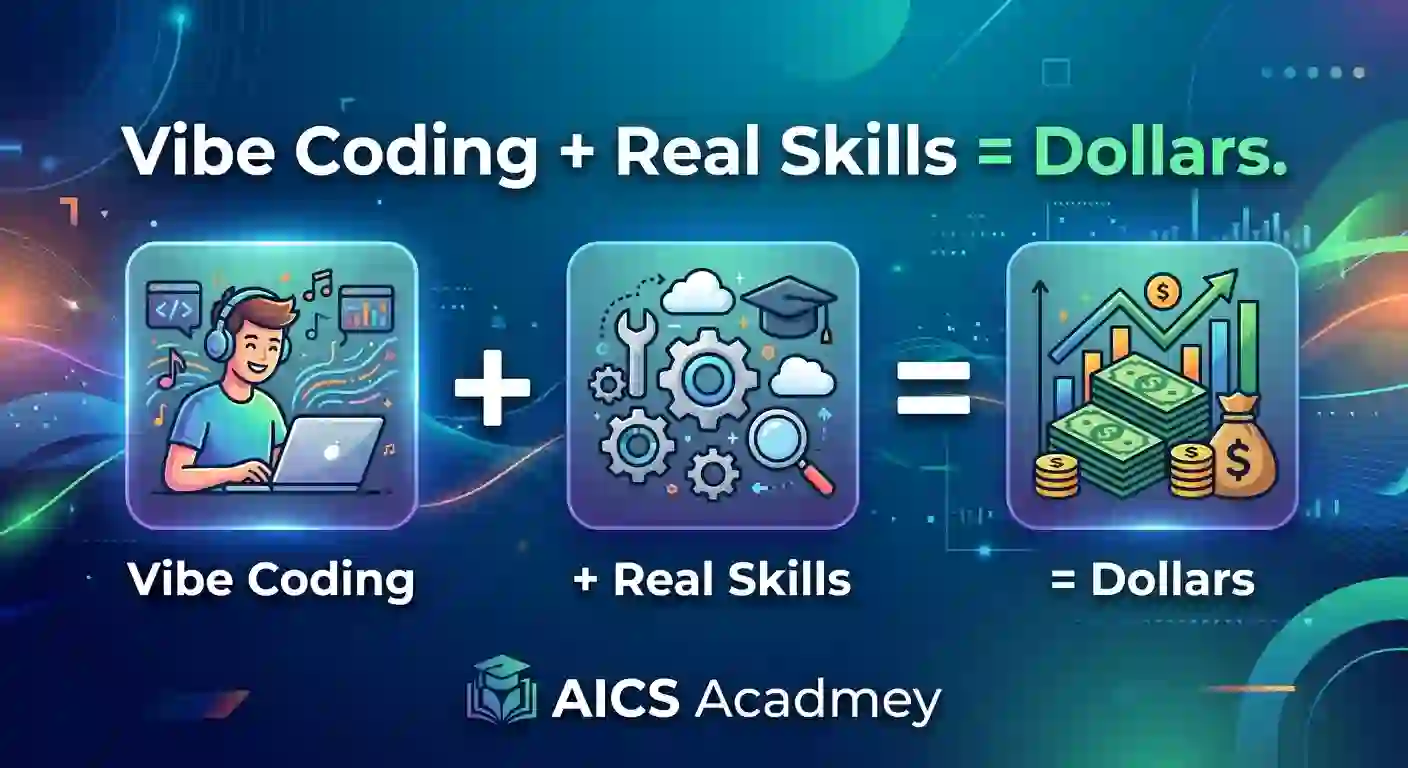
Vibe coding means building software by describing it to AI. It is powerful, but beginners who skip the basics get stuck fast. This guide explains what to learn, which tools to use, and how to turn it into freelance income.
Table of contents
Table of Contents
Imagine typing “build me a booking website for my clinic” and watching a working page appear in minutes. A few years ago that sounded like science fiction. In 2027 it is a normal Tuesday for thousands of people.
This style of building is called vibe coding, and it has changed how software is made. It has also created a dangerous myth: that coding skills no longer matter. This guide explains what vibe coding is, where it works, where it fails, and how students and freelancers in Faisalabad can use it to earn in dollars.
What Is Vibe Coding?
AI researcher Andrej Karpathy popularised the term in early 2025. He described a way of working where you tell the AI what you want and accept what it produces, without reading every line of code.
“Fully give in to the vibes.”
— Andrej Karpathy, AI researcher
The idea spread quickly. Dictionary publisher Collins named “vibe coding” its Word of the Year for 2025. In practice, it works like this:
You describe the product in plain English (or Urdu).
An AI tool generates the code, design and structure.
You test, correct and repeat until it works.
You are no longer typing every line. You are directing, reviewing and deciding, much like a manager guiding a very fast junior developer.
Why Everyone Is Talking About It
The numbers show how fast AI has entered programming.
Stack Overflow’s 2025 Developer Survey found that around 84% of developers use or plan to use AI tools, up from about 76% the year before.
The World Economic Forum expects 39% of core job skills to change by 2030, with technology skills growing fastest.
Pakistan’s IT and IT-enabled services exports have passed $3.8 billion in a year, and freelancing is a growing share of that.
Small businesses worldwide are looking for cheap, fast websites, automations and apps, and many now accept AI-assisted delivery as long as it works.
The result is a bigger market, not a smaller one. More people want software, and the person who can deliver it quickly and correctly wins the work.
What Vibe Coding Does Well
Vibe coding shines in these situations:
Prototypes and MVPs: test an idea in a weekend instead of a month.
Landing pages and simple websites: clinics, schools, shops, portfolios.
Internal tools: dashboards, calculators, trackers, form handlers.
Automations and scripts: renaming files, cleaning spreadsheets, sending reports.
Learning: asking AI to explain code line by line is like having a patient tutor.
For a small business owner in Faisalabad, this means a working website or order tracker in days, not weeks.
Where Vibe Coding Breaks (The Part Nobody Posts About)
Here is what the viral demos leave out.
AI writes confident mistakes. Code can look perfect and still contain bugs, broken logic or security holes.
You cannot fix what you cannot read. When the app crashes at midnight, “ask the AI again” does not always work.
Security and privacy risks. Hard-coded passwords, exposed databases and unsafe forms are common in AI-generated projects.
Messy structure. Projects built by pure prompting often become impossible to maintain after the first few changes.
Clients pay for outcomes. A client does not care how the code was written. They care that it is fast, safe and does not break.
“A compiler tells you it runs. A teacher tells you it’s good.”
— AI Computer Science Academy
That is the gap. AI helps you run code. Skill tells you whether the code is good.
Vibe Coding vs Real Coding: Which Should You Learn?
This is a false choice. The strongest people in 2027 do both.
If anyone can generate a basic website, basic websites become cheap. What stays valuable is judgment: knowing what to build, spotting errors, and making the result reliable.
6 Skills That Make Vibe Coding Actually Pay
Python basics: variables, loops, functions, lists. Enough to read and edit what AI writes.
HTML, CSS and JavaScript: the foundation of every website you will ever build.
SQL: nearly every real app stores data, and SQL is still among the most requested skills in job ads.
Prompting with context: clear, specific instructions give far better code than vague ones.
Testing and debugging: the habit of checking every output before it reaches a client.
Git and GitHub: version control and a public portfolio that proves your work.
You can practise the first four today in a free browser compiler, with nothing to install.
Your 60-Day Plan to Go From Beginner to First Client
Days 1 to 20: Learn to read code
Run small Python, HTML and SQL programs in a free online compiler.
Ask an AI tool to explain every line you do not understand.
Goal: write and explain 20 short programs.
Days 21 to 40: Build with AI, review like a developer
Create three small projects: a personal portfolio page, a fee calculator, and a student list with SQL.
Use AI to generate code, then test it and fix at least three issues yourself.
Goal: three working projects on GitHub.
Days 41 to 60: Package and sell
Pick one niche, such as clinics, schools, restaurants or textile traders.
Build a simple demo site or tool for that niche.
Create profiles on freelancing platforms and write five clear gig descriptions.
Message ten local businesses with a short demo.
Goal: one live portfolio and your first paid conversation.
Ways to Earn With These Skills
Website building for local shops, schools and clinics (WordPress plus AI).
Small web tools and calculators for businesses that still use paper or Excel.
Bug fixing and cleanup of websites that other people created with AI. This is a growing service.
Automation scripts that save a business hours every week.
Teaching and tutoring beginners once you have learned the path yourself.
Income depends on effort, portfolio quality and consistent outreach, so treat any earning claims as possibilities rather than promises.
Common Mistakes to Avoid
Copy-pasting without understanding. If you cannot explain it, you cannot support it.
Skipping testing. Always run the code with wrong inputs, not just the happy path.
Sharing secrets. Never paste passwords, API keys or client data into an AI tool.
Chasing every new tool. Pick one AI assistant and one editor, and go deep.
Learning in isolation. Feedback from a teacher speeds up progress more than another tutorial video.
Who Should Start Now?
Students unsure about their future who want to test IT before choosing a degree.
Job holders who want a second income skill without quitting work.
Freelancers who want to move from low-paid tasks to higher-value projects.
Business owners who want to build their own tools and websites faster.
Frequently Asked Questions
Is vibe coding the same as no-code?
Not exactly. No-code uses drag-and-drop tools. Vibe coding uses AI to generate real code that you can edit.
Will AI replace programmers?
AI is changing the work, not erasing it. Routine tasks are automated, while people who understand, review and direct the code stay in demand.
Do I need a computer science degree?
No. Many freelancers and developers are self-taught or trained in short courses. A strong portfolio matters more than a certificate alone.
Can I practise without installing software?
Yes. Our free online compiler runs 15 languages in your browser, with no signup.
How long does it take to start earning?
It varies. Many learners build their first sellable project in 60 to 90 days with steady practice.
Final Thoughts
Vibe coding is not a trick and not a threat. It is a faster way to build for people who understand what they are building. Use AI to move quickly, and use your own knowledge to keep the result safe, clean and valuable.
Start small this week. Open a compiler, write a few lines, break something, fix it, and ask why it broke. That habit will serve you for the next ten years of technology.
Ready to begin?
👉 Try the free coding lab (15 languages, no install)
👉 Join a coding or Agentic AI course at AI Computer Science Academy, Faisalabad
👉 Book a free counselling call to find the right path